


 English
 中文简体
中文简体
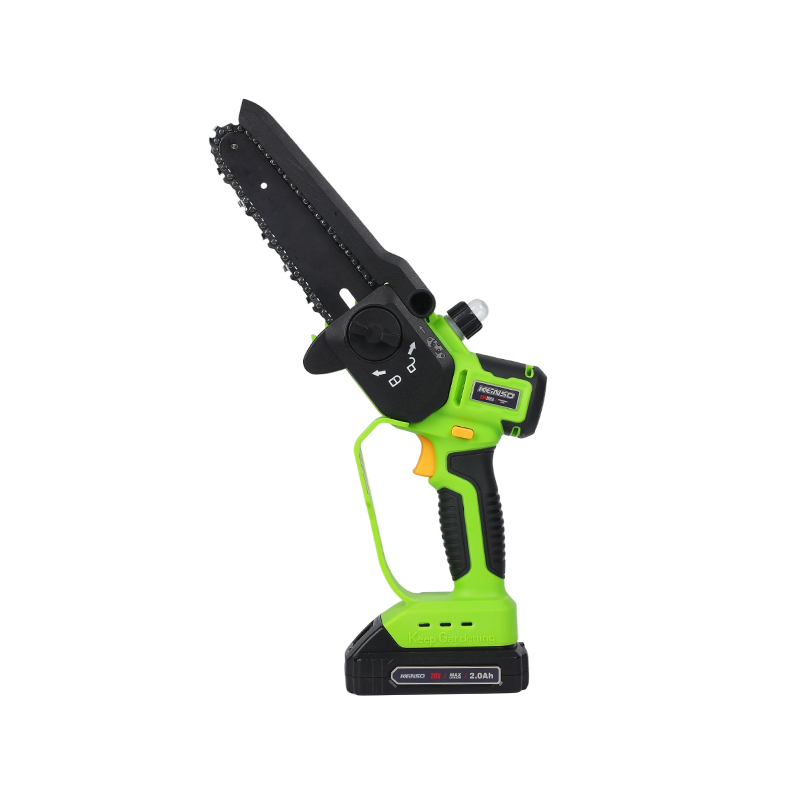
A lopper handles twigs. A chainsaw handles trunks. Between them, a tool with a six-inch bar and a brushless motor cuts branches the thickness of a wrist without weighing down the user's arm. A 6-inch brushless lightweight pruning saw runs on a lithium battery, starts with a trigger, and stops with a release. No pull cord. No fuel mix. No cloud of blue smoke in the orchard. Arborists carry it on a harness. Landscapers grab it for ornamental pruning. Homeowners pull it off the shelf when a storm leaves limbs across the driveway.
Why Brushless Makes Sense on a Short Bar
Brushed motors waste energy as heat where the carbon brushes rub the commutator. A brushless motor replaces the brushes with an electronic controller. Less friction. Less heat. More of the battery's energy goes into spinning the chain.
On a six-inch bar, the motor does not need to pull a long loop of chain through hardwood. It needs to spin fast and maintain torque as the teeth bite into green branches. A 6-inch brushless lightweight pruning saw with a brushless motor holds chain speed under load better than a brushed equivalent. The battery lasts longer per charge. The motor does not eat brushes because there are none to eat.
Weight is the other reason brushless works here. A brushless motor packs more power per gram. The saw comes in under one and a half kilos with the battery. One-handed operation leaves the other hand free to hold a branch or steady a ladder. Overhead cuts do not torch the user's shoulder by the third branch.
Six Inches of Bar, Four Inches of Cut, Zero Drama
Bar length sets the big cut. A six-inch bar handles roughly four to five inches of green wood, about the diameter of an apple tree branch or a mature shrub stem. A low-kickback chain on a narrow-kerf bar slices through without grabbing. Chain speed sits around five to six meters per second.
Chain tension drifts as the chain heats and stretches. A tool-free tensioning knob lets the user snug it back in seconds without a wrench. An automatic oiler feeds the bar from a small reservoir. A transparent window shows the oil level. Forget to check and the chain runs dry against the wood, dulling fast.
Here is what the saw needs to work all day:
- Brushless motor on a 20V or 40V shared battery system
- Total weight under one and a half kilos with battery
- Six-inch bar with tool-free tensioning and low-kickback chain
- Automatic oiler with visible reservoir
- Trigger lockout and chain brake for overhead safety
Cutting Where the Branches Actually Grow
Fruit trees branch in every direction. The cut might be at chest height, overhead, or buried inside a dense canopy. A 6-inch brushless lightweight pruning saw with a top-handle grip works at any angle. The operator reaches in, positions the bar, and pulls the trigger. The short bar fits into tight branch angles where a longer bar would hit adjacent limbs.
Orchard crews carry the saw on a harness hook. It hangs at the hip until a branch needs cutting. Landscapers drop it in a tool bag and move from job to job. No cord. No fuel. No noise complaint from the neighbor.
What Fails When the Saw Meets the Ground
The chain derails if tension is too loose. A bar that holds adjustment and a chain that resists stretching keep the chain in the groove. The battery latch takes the impact when the saw falls. A latch that cracks on the first drop leaves the battery loose and the saw useless. The oiler port clogs with fine sawdust. A port that clears without tools gets cleaned. A port that requires disassembly does not.
A 6-inch brushless lightweight pruning saw replaces loppers for anything thicker than a finger and replaces a gas saw for anything thinner than a thigh. It runs on batteries already in the truck. It weighs less than a lunchbox. Choose a saw with a brushless motor, a solid bar, and a chain that stays where it is adjusted. The branches drop. The arms don't. That is the entire idea.
 Previous

